REVIEW · PHILADELPHIA
90 Minute History Walking Tour of Old City Philadelphia
Book on Viator →Operated by WeVenture · Bookable on Viator
Old City Philadelphia rewards close attention. This 90-minute history walk strings together the big moments of the American Revolution era and the everyday people behind them, using a local guide who also helps you plan the rest of your trip. You’ll cover the Independence Hall area, pass the Liberty Bell, and finish with streets and courtyards that feel like you stepped back into the 1700s.
I like the small group size (max 16), because it makes questions feel normal, not awkward. I also like that the guide doesn’t just recite dates—they point out details you’d otherwise miss, including photo-ready spots on preserved streets. One thing to consider: this is a story-led tour, so the guide’s style matters, and if you want only strictly neutral facts, you may want to choose your time slot wisely.
In This Review
- What You’ll Love Most (and One Thing to Watch)
- Key Highlights You Should Actually Care About
- Entering Old City with a Game Plan
- Signer’s Garden Start: Where You Begin Thinking Like a Local
- Independence Hall: The 1776 Declaration and 1787 Constitution Thread
- Liberty Bell Pass-By: Freedom You Can See from the Street
- Benjamin Franklin’s Grave: The Resting Place That Explains the Man
- US Mint: Where the Stories Show Up in Your Pocket
- Betsy Ross from the Street: A Flag Story with Real Setting
- Quaker Meetinghouse Courtyard: Faith and Community in Early Philadelphia
- Elfreth’s Alley: The 1700s Street You Actually Want to Walk
- How the Guides Make the Difference
- What’s Included, What Isn’t, and How to Plan Your Day
- Who This Tour Fits Best
- Should You Book This Old City History Walk?
- FAQ
- How long is the 90 Minute History Walking Tour of Old City Philadelphia?
- How much does the tour cost?
- Where does the tour start and end?
- Is the tour offered in English?
- Do I need printed tickets?
- How big is the group?
- What’s included in the price?
- What’s not included?
- Is Elfreth’s Alley included?
- Are service animals allowed?
- Can I cancel and get a refund?
What You’ll Love Most (and One Thing to Watch)
The best part is pacing with purpose: you get enough time at key stops to understand why each site matters, without feeling stuck. I also appreciate the practical extras—like the guide’s recommendations for the rest of your Philadelphia days, which can save you hours of guesswork.
The possible downside is style variation. One guest complained about spending too long in the same area and feeling the talk drifted into opinion. You can’t control every guide’s delivery, so if you’re easily thrown off by tangents, I’d go in expecting conversation and viewpoints, not a silent museum script.
Key Highlights You Should Actually Care About
- Independence Hall area focus: independence in 1776 and the Constitution era in 1787, all in one concentrated route
- Liberty Bell pass-by: you get the story behind the bell even when you’re not going inside
- Benjamin Franklin’s graveside stop: you’ll learn why an unassuming marker still matters
- US Mint photo stop: see the institution tied to circulating coinage
- Elfreth’s Alley at the end: a classic 1700s street with real texture and charm
- Guides share trip tips: you’ll leave with ideas beyond the tour route
You can also read our reviews of more walking tours in Philadelphia


Entering Old City with a Game Plan
Old City can feel like a blur when you arrive with a map and no context. This tour helps you get oriented fast by walking a tight loop through the sites that define early American identity, then slowing down for the quieter clues—courtyards, narrow streets, and unmarked-leaning historical moments.
At 90 minutes, it’s short enough to fit between museum stops, but long enough to connect the dots. The tour runs in English, uses a mobile ticket, and is capped at 16 people, which usually means better back-and-forth and less waiting around.
Also, a practical heads-up: it’s commonly booked ahead—on average about 20 days out. If you’re traveling in peak season or on a weekend, book earlier so you’re not stuck with a time that doesn’t match your day plan.
Signer’s Garden Start: Where You Begin Thinking Like a Local
You start at Signer’s Garden, 434–498 Chestnut St, Philadelphia. That matters more than you’d think. Beginning in a place tied to the city’s political story sets the tone: you’re not just touring monuments, you’re walking through the setting where ideas became policy.
From the start, expect your guide to frame what you’re seeing and what to notice. The tour style is built around those quick “wait, look at that” moments—details on buildings, street layout, and the way Old City is still shaped by centuries-old planning.
If you’re doing other Philadelphia sights the same day, this start gives you a workable mental map. You’ll know what to hit next and what can wait.
Independence Hall: The 1776 Declaration and 1787 Constitution Thread
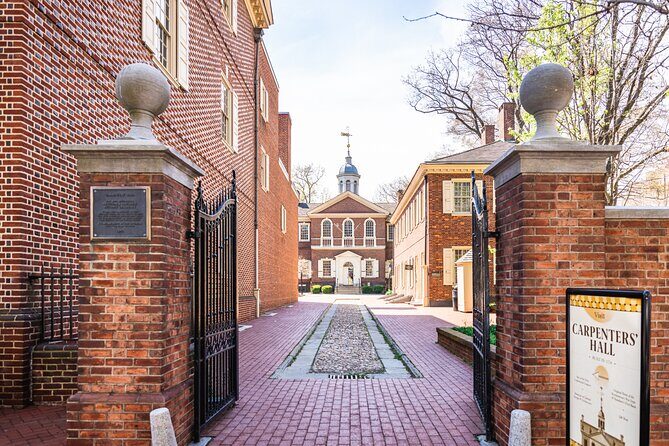
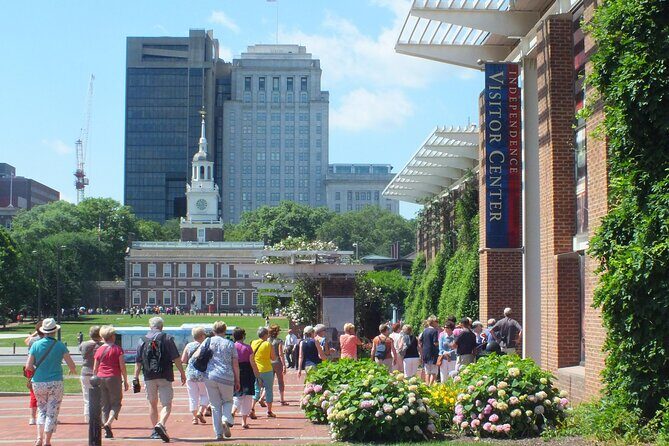
One stop centers on the building tied directly to the birth of the United States. You’ll hear how, in 1776, Congress declared independence from the British Empire. Then you’ll connect that to 1787, when the founders created the U.S. Constitution.
That two-step story is the value here. A lot of visitors see these places as one big event. A good guide helps you feel the sequence: break from empire first, then build a system that could actually hold. The walking format keeps it from feeling like a textbook lecture, because you’re hearing the story while your feet move through the same historic zone.
One small drawback: because this part is extremely popular, the area can be busy at many times of day. A guide helps you cut through the noise by telling you where to focus—what to photograph, what to mentally label, and how to connect it to later stops.
Liberty Bell Pass-By: Freedom You Can See from the Street
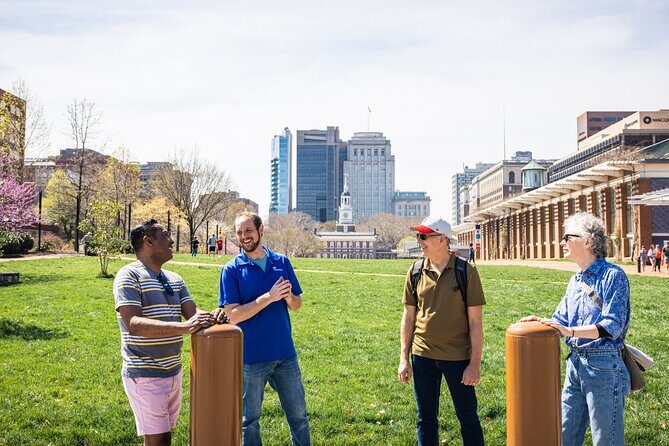
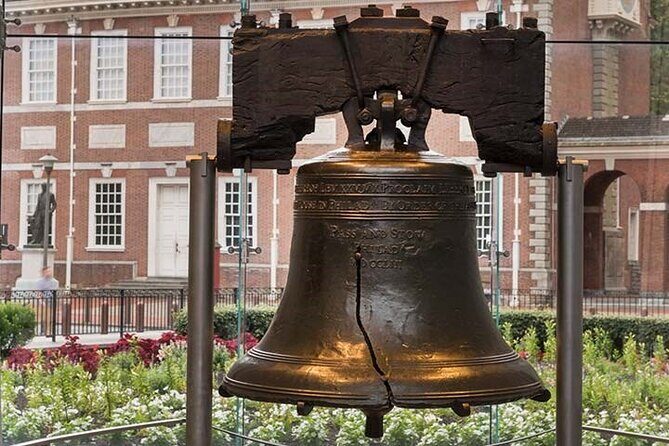
Next comes the Liberty Bell, viewed from the outside. Even without going inside, you still get the “why this bell won’t go away” story—how it became the enduring symbol of freedom and why people still treat it like a landmark with a pulse.
This pass-by is useful because it teaches you to look past the postcard. You’re not just seeing a famous object; you’re learning how meaning gets built over time, and how Americans re-use symbols during new moments of stress and hope.
Photo tip: if you’re taking pictures, treat this stop like a short sprint. Shoot, then listen. The bell’s story is what makes the photo worth keeping.
You can also read our reviews of more city tours in Philadelphia
Benjamin Franklin’s Grave: The Resting Place That Explains the Man
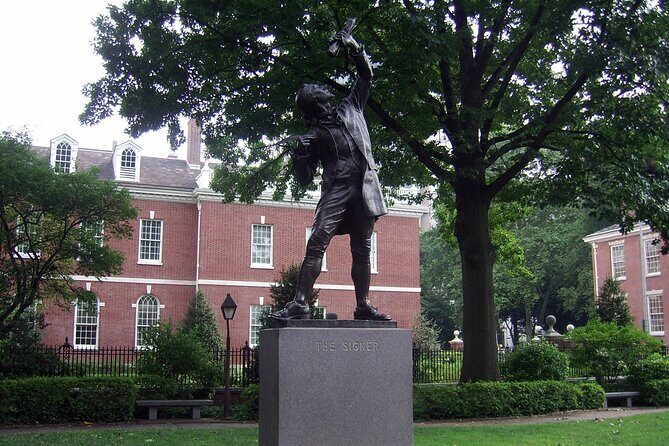
Then you’ll walk to a stop near Benjamin Franklin’s resting place, including the detail that lies under an unremarkable tombstone. Franklin’s story covers a wide range—printer, politician, scientist, philanthropist—and your guide is expected to connect those dots so you see him as more than a face on a coin.
This stop can be surprisingly moving because the marker itself doesn’t scream importance. That’s the point. You’ll learn to read what’s quiet—why people remember Franklin so intensely even when the location feels simple.
I also like this moment for families and students. It gives you a “human scale” break from the heavier political sites. If you enjoy history that feels personal—people shaping the future with habits and curiosity—this stop will land well.
US Mint: Where the Stories Show Up in Your Pocket
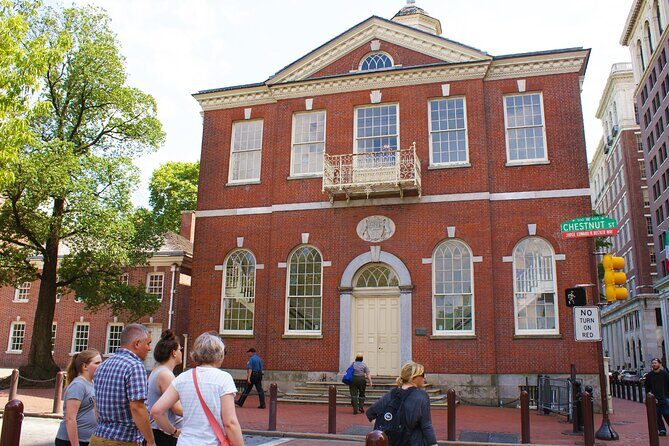
You’ll also pass the U.S. Mint in Philadelphia, described as the largest mint in the world and the place that produces most U.S. coins in circulation. It’s a short stop, but it clicks into something practical: you’ll walk away thinking about how national identity isn’t only written in documents—it also gets stamped into everyday objects.
The guide’s framing can make this part fun even if you’re not a coin nerd. The tour even gives you a quick reminder about value in small change. It’s the kind of line that makes history feel less abstract.
One note: since this is a pass-by, don’t expect a deep behind-the-scenes production tour. But do expect context on how institutions tied to money and government show up across American life.
Betsy Ross from the Street: A Flag Story with Real Setting
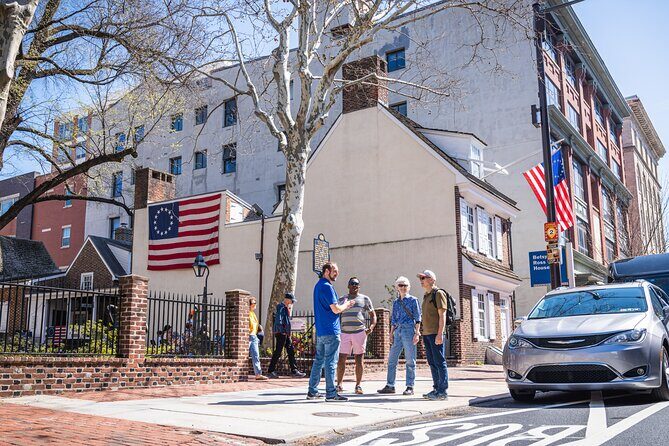
Another stop focuses on the idea that Betsy Ross lived in an 18th-century home where she created the first American flag. You’ll hear that story from outside her charming home, which helps keep the tour moving while still putting the legend in a real physical place.
Betsy Ross is one of those stories where people have opinions. Here, the value is in how a guide presents the tale alongside the streetscape around it—turning an oft-repeated claim into something you can picture on a walk.
If you like history that mixes known narratives with local interpretation, this will be one of your more memorable photo moments.
Quaker Meetinghouse Courtyard: Faith and Community in Early Philadelphia
You’ll then visit the courtyard area of the largest Quaker meetinghouse in the region, with a focus on a Christian community that was a predominant religion in early Philadelphia.
This stop is important because it expands the tour beyond only revolutionary political leaders. It helps you understand that the early United States wasn’t just debates in meeting halls. It was also communities with distinct beliefs, rhythms, and rules about everyday life.
The courtyard setting is also a nice change of pace. After statues-and-facades stops, you get something that feels more enclosed and human. If you find yourself zoning out during purely political storytelling, this is a good reset.
Elfreth’s Alley: The 1700s Street You Actually Want to Walk
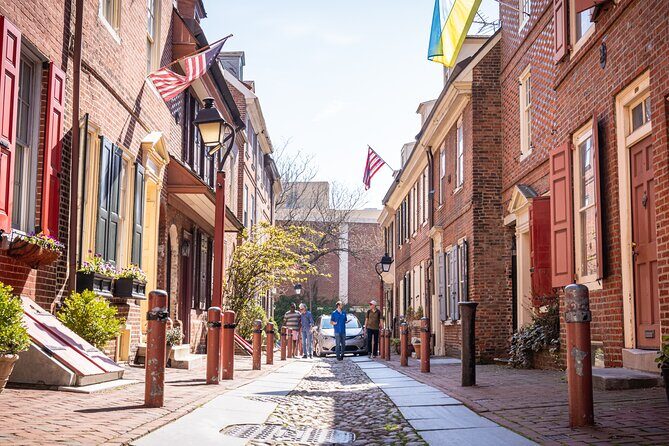
The tour continues with Elfreth’s Alley, a street lined with quaint homes dating to the 1700s. You’ll learn it’s known as the oldest continuously residential street in the former 13 British Colonies—meaning it’s not only old, it’s been lived on for an astonishing stretch of time.
This is the stop that tends to make people smile because it feels like a time machine without needing special effects. It’s also where you’ll understand why Old City works: the street layout and building scale do a lot of the storytelling for you.
Admission here is free, and that’s a plus. You can take your time, photograph along the way, and enjoy the “how would daily life feel here?” moment.
If you’re traveling with kids or teens, Elfreth’s Alley is often the easiest sell. It’s easy to visualize history when the street is right in front of you.
How the Guides Make the Difference
The tour is led by local, English-speaking guides, and the delivery seems to be a big part of the experience. In the past, guides such as David, Caroline, Jonathan M., and John (including John D.) have been praised for friendly, personable teaching and for adding a lot of detail at each stop.
What I’d take from those positive patterns for your own planning: bring questions. If you ask about how the Constitution era connects to earlier events, or why certain symbols stuck, guides tend to respond with more than dates.
Also, some feedback highlights a cold-day upside—people found it enjoyable even when the weather wasn’t cooperating. That’s a strong hint that pacing is built to keep you moving. Still, wear layers and expect an outdoor walking tour feel.
What’s Included, What Isn’t, and How to Plan Your Day
This tour includes:
- A local English-speaking guide
- Fascinating stories of Philadelphia’s historically significant sites
- A donation to a local nonprofit historic organization
- The core walking experience through Old City
It does not include:
- Additional food and drink
- Souvenirs or personal shopping
So plan simple. If you want snacks, grab them before you start or after you finish—Old City has plenty of options. You’ll also appreciate having water, especially in warm months.
Because it ends in the heart of Old City Philadelphia, it’s a convenient add-on to other nearby stops. If you’re stacking museums or historic homes, I’d treat this as the “thread-maker” tour: it helps your brain connect what you see later.
Who This Tour Fits Best
This 90-minute walk is a strong match if:
- You’re a first-time visitor to Philadelphia and want the high-impact overview of early America
- You like history with stories, not just plaques
- You’re traveling with a teen (a 13-year-old on a recent trip followed along and had questions)
- You want a guide’s recommendations for the rest of your schedule
It might be less ideal if:
- You’re extremely sensitive to any guide opinions or political framing (one guest felt the delivery became political)
- You hate Q-and-A or being asked direct questions during the walk
Should You Book This Old City History Walk?
I think this is worth booking if you want a focused 90-minute route through the Independence Hall orbit, with Liberty Bell, Franklin, the Mint, Betsy Ross, Quakers, and Elfreth’s Alley all in one smooth storyline. The $29 price makes sense because you’re paying for guided interpretation plus a donation, not just entrance to a single site.
If you’re short on time, it’s a smart way to get context fast. If you’re staying a couple days, it’s even better because the guide’s trip recommendations can steer you toward what to do next without wasting time.
My advice: book ahead, wear comfy shoes, and be ready to look up at details you might otherwise ignore. If you do that, you’ll leave Old City feeling like you understand the place, not just that you visited it.
FAQ
How long is the 90 Minute History Walking Tour of Old City Philadelphia?
It runs for about 1 hour 30 minutes (approx.).
How much does the tour cost?
The price is $29.00 per person.
Where does the tour start and end?
It starts at Signer’s Garden, 434–498 Chestnut St, Philadelphia, PA 19106 and ends in the heart of Old City Philadelphia.
Is the tour offered in English?
Yes, it’s offered in English.
Do I need printed tickets?
No. The tour uses a mobile ticket.
How big is the group?
The tour has a maximum of 16 travelers.
What’s included in the price?
You get a local, English-speaking guide, stories of key historic sites, and a donation to a local nonprofit historic organization.
What’s not included?
Food and drink and souvenirs/personal shopping are not included.
Is Elfreth’s Alley included?
Yes, Elfreth’s Alley is part of the route, and admission ticket is free.
Are service animals allowed?
Yes, service animals are allowed.
Can I cancel and get a refund?
Yes. Free cancellation is available up to 24 hours in advance for a full refund. If you cancel less than 24 hours before the start time, it isn’t refunded.