REVIEW · PHILADELPHIA
One Hour Tour Of Philadelphia Historical Sites In A Vintage Car
Book on Viator →Operated by Philly City Tour · Bookable on Viator
Philly in 60 minutes sounds too fast—until you’re in motion. This is a short, classic-car tour that strings together major landmarks with real stories, so you get your bearings fast without spending your whole day in lines. I like that you cover a lot of ground in just one hour, and I love that the guide keeps it funny and personal, not like a lecture.
One thing to think about: it’s an open-air vintage-style ride, so cold or wind can be a bigger factor than you expect.
In This Review
- Quick Picks: What Makes This Tour Worth It
- Why a One-Hour Vintage Car Tour Makes Sense in Philly
- Start Point at 51 N 12th St: Easy to Find, Easy to Return From
- The City Hall Story: 22-Foot-Thick Walls and the Penn Statue Above
- Philadelphia Museum of Art: A Quick Hit With Big Name Recognition
- Philadelphia’s Magic Gardens: Isaiah Zagar’s Mosaic Maze
- Elfreth’s Alley: America’s Oldest Continuously Lived-On Street
- The United States Mint: Coins, History, and Scale You Can Feel
- Liberty Bell: The Bell’s Role in Public Announcements
- Independence Hall: Where the Declaration and Constitution Happened
- Chinatown: A Neighborhood With Roots From the 1870s–1880s
- The National Constitution Center: A Fast, Modern Way to Learn
- Reading Terminal Market Stop: Why Food Makes History Stick
- Price and Value: Is $39 for One Hour Reasonable?
- What to Bring: Warm Layers, Photo Readiness, and a Plan for Sound
- Guides Who Make It Feel Like a Story, Not a Script
- Should You Book This One-Hour Vintage Car Tour?
- FAQ
- How long is the Philadelphia historical sites vintage car tour?
- What is the price per person?
- Where do I meet the tour?
- Is the tour offered in English?
- Is admission included for the Philadelphia Museum of Art or Magic Gardens?
- How large is the group?
- Are tips included in the price?
- Can I cancel for a full refund?
- Are service animals allowed?
Quick Picks: What Makes This Tour Worth It
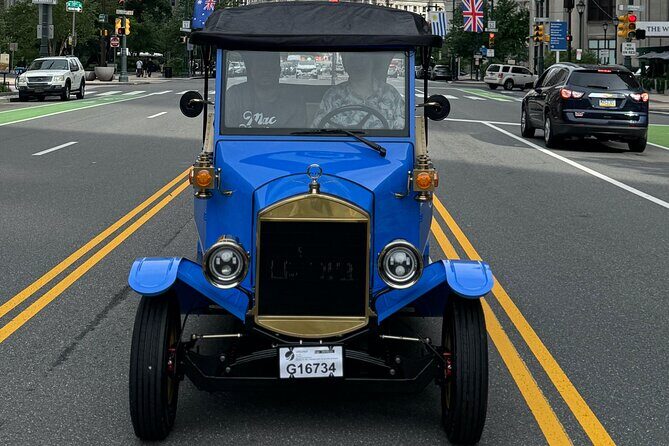
- Vintage car sightseeing that feels special from the first turn
- Short, well-paced stops that work when you have limited time
- Top Philly landmarks in one loop, including City Hall, Independence Mall, and Elfreth’s Alley
- Small group size (maximum 7), which makes questions easier
- Weather matters and there’s no setup for escaping cold on the drive
- Hearing can be tricky from the back seat in an open car
Why a One-Hour Vintage Car Tour Makes Sense in Philly
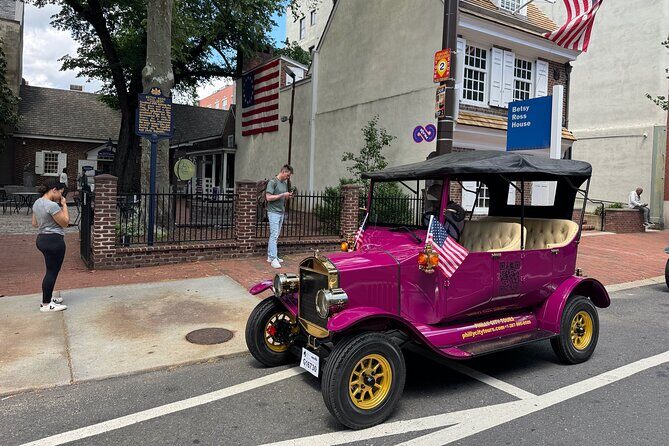
Philly has serious “big deal” sights, but they’re spread out. This tour solves that problem with a tight route: you’re not picking between museums, historic streets, and civic landmarks—you’re stacking them in one loop. The payoff is simple: you leave with a mental map of where everything is, and what matters about each place.
The vintage car part isn’t just decoration. It helps you slow down enough to notice details, like civic architecture, old neighborhoods, and the way neighborhoods change block by block. And because the ride is short, the guide can spend more time on the story behind each stop rather than rushing through logistics.
You should know one practical tradeoff. The tour is designed for quick exterior viewing and short photo/step-out moments. If you want to linger inside every building, you’ll still want a longer visit later.
You can also read our reviews of more historical tours in Philadelphia


Start Point at 51 N 12th St: Easy to Find, Easy to Return From
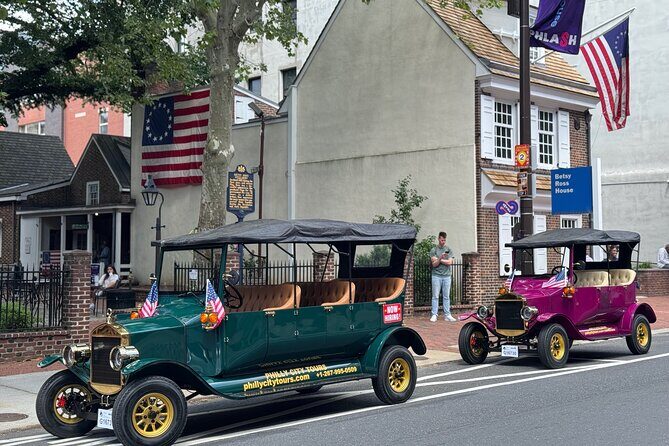
The tour starts and ends at 51 N 12th St, Philadelphia (19107). That matters because there’s no “make your own way back” chaos at the end—you end up right where you began.
In practice, I like this start location because it’s close to Reading Terminal Market in the general area. That makes it easy to pair your tour with food afterward. If you’re arriving by public transit, you’ll also find you’re not stuck in the middle of nowhere; the start point is near normal city routes.
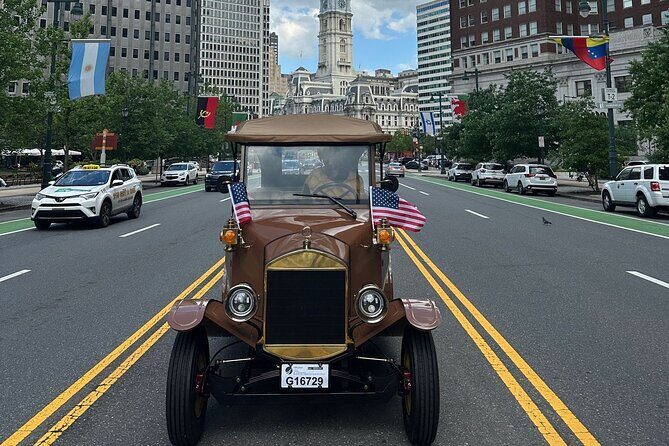
The City Hall Story: 22-Foot-Thick Walls and the Penn Statue Above
One of the first civic stops is Philadelphia City Hall, and the scale of it hits fast. You’ll hear how construction took years and cost an enormous amount for its time. The details are the kind that make architecture feel like a character: thick stone walls—22 feet—and a tower that once topped the skyline.
Here’s what I think you’ll appreciate: you’re not just looking at a landmark from the sidewalk. You’re getting the “why it was built” context and the “why it still matters” angle. And then you get the iconic top feature: the 37-foot statue of William Penn, noted as the largest statue atop any building in the world.
This stop is also a useful reminder for first-time visitors. City Hall isn’t only pretty. It helps you understand how Philadelphia planned to show off power, ambition, and civic pride.
Philadelphia Museum of Art: A Quick Hit With Big Name Recognition
Next up is the Philadelphia Museum of Art (PMA). It’s a major art destination, originally chartered for the Centennial Exposition in 1876. During the short stop, you’re taking in the setting and the exterior presence, not planning a full museum day.
Important value note: PMA admission is not included, so don’t plan on using this as your only museum visit. If you already love art museums, this stop will likely make you want to go back for the galleries later.
In the time you have, though, you can still get a lot out of the location. The museum sits in a way that helps you see the city’s geography—what’s downtown, what rises, and how the city opens up as you look outward.
Philadelphia’s Magic Gardens: Isaiah Zagar’s Mosaic Maze
From grand civic architecture to street-level imagination: Philadelphia’s Magic Gardens is created by mosaic artist Isaiah Zagar. The story you’ll hear is part of the point: what started as a vacant lot became a complex maze of tiles, glass, mirrors, and found objects—built over years.
This stop is short, and admission is not included. That means you may get more from the exterior vibe and quick orientation than a full walk-through. Still, it’s worth it. Magic Gardens is the kind of place that makes Philadelphia feel creative and slightly quirky—in a way that a monument never does.
What to consider: if it’s crowded or weather is rough, you’ll want to move efficiently. Bring your patience for a quick artistic snapshot, not a slow-stroll experience.


Elfreth’s Alley: America’s Oldest Continuously Lived-On Street
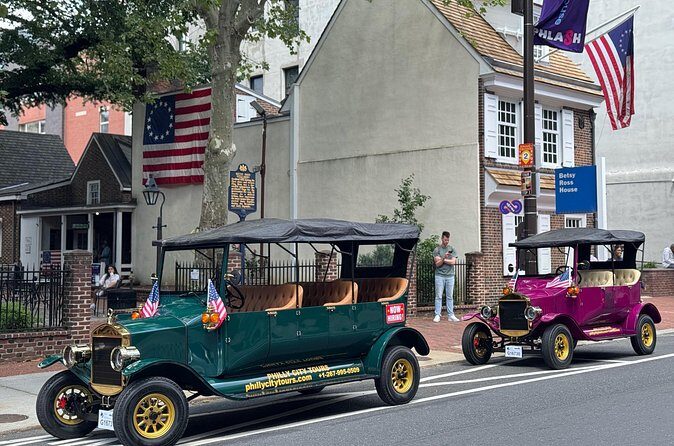
Elfreth’s Alley is one of those stops that feels like time travel without needing a theme park. The street dates to 1702 and is known as the oldest continuously lived-on residential street in America.
You’ll see a row of old brick houses that span centuries, originally linked to trades like blacksmiths, merchants, and immigrants. The street today looks very close to how it did long ago, with cobblestone and colonial-style homes. If you want to learn a bit more, you can visit the Elfreth’s Alley Museum to see inside two preserved homes.
Best part: the stop is free, and it’s a very “human scale” moment in a tour that mostly hits large institutions. It gives your brain a break. You go from towers and museums to doorways and street life.
The United States Mint: Coins, History, and Scale You Can Feel
The next stop is the United States Mint in Philadelphia, established in 1792. It’s described as the largest of the four active U.S. mints. Even if you don’t go inside, hearing what the mint produces—circulating coins, commemorative coins, and medals—gives the site more meaning than just “it’s a building.”
This is a smart stop for short-timers because it adds a practical, everyday connection to national history. You get a sense of how civic America created systems that still run today.
One consideration: with quick tours, your time may be more about exterior viewing and story than deep exploration.
Liberty Bell: The Bell’s Role in Public Announcements
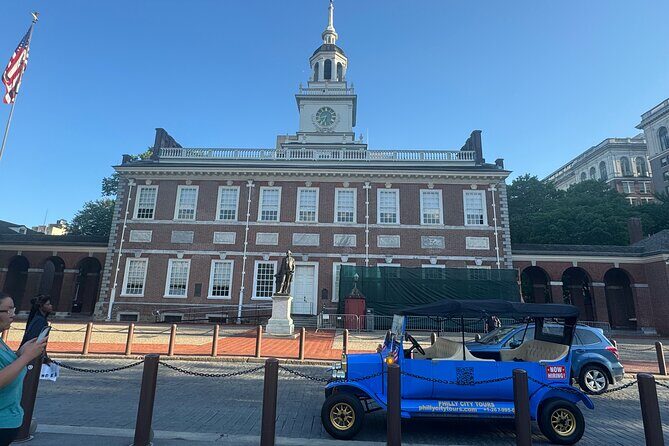
The Liberty Bell is the headline for many people, and this tour addresses it with context. You’ll hear that the bell was used as the official bell of the Pennsylvania State House—now called Independence Hall—and rang for public announcements.
The story gets specific: it may have rung on July 8, 1776, for the first public reading of the Declaration of Independence. You’ll also learn the detail that it weighs about 2,000 pounds and was silenced by a crack in 1846.
Practical note: access can vary. There was an instance where the bell wasn’t viewable up close due to government shutdown conditions, but the tour still included a stop. That’s a good reminder to pack your expectations accordingly: think photo moment and viewpoint, not a guaranteed front-row view every time.
Independence Hall: Where the Declaration and Constitution Happened
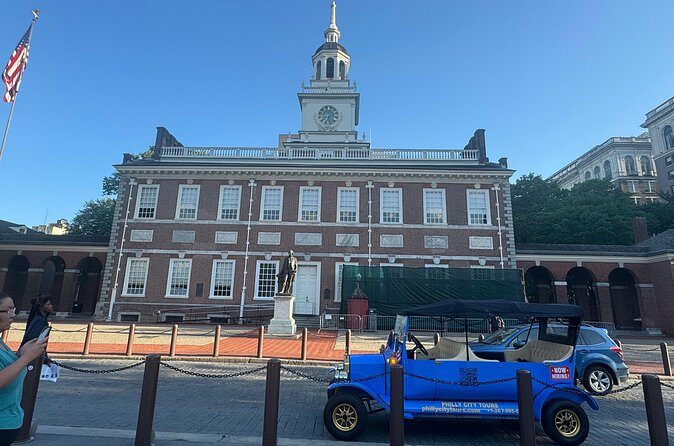
Independence Hall is the big one for many history-focused trips, and the tour frames it clearly. You’ll hear it was built in 1732 as the Pennsylvania State House. It’s where the Second Continental Congress met in May 1775 and where the Declaration of Independence was adopted on July 4, 1776.
The tour also connects the hall to the Constitution: the Constitutional Convention met there, debated, and then signed the U.S. Constitution on September 17, 1787.
This stop is valuable because it turns dates into a narrative. You’re not just looking at a famous building—you’re remembering what happened inside and why people cared. For a one-hour experience, that clarity matters.
Chinatown: A Neighborhood With Roots From the 1870s–1880s
Next is Philadelphia’s Chinatown, with a story that goes beyond the food and storefronts. The neighborhood’s roots trace back to the 1870s and 1880s, when Chinese immigrants arrived.
Today, Chinatown reflects multiple Asian cultures, including people and communities connected to Korea, Thailand, Vietnam, and more. It also has an active community feel with shops, authentic cuisine, and cultural events.
This stop feels like a reset after the solemnity of civic landmarks. It shows you Philadelphia as a living city, not a collection of monuments. Even if you don’t go deep into the neighborhood during the short stop, you’ll understand where to explore later when you have more time.
The National Constitution Center: A Fast, Modern Way to Learn
The National Constitution Center sits on Independence Mall, and it’s described as the first museum in the world devoted to telling the story of the U.S. Constitution—past to present. You’ll hear about a heavy focus on interactive and multimedia exhibits, plus film, photographs, text, sculpture, and artifacts, with more than 100 exhibits.
This is a smart pairing for a short tour. You can stand outside and learn what kind of experience the museum offers, even if you don’t have time to enter. It’s also a helpful “bridge” between the historic Independence Hall stop and the broader idea of how the Constitution keeps shaping the country.
Because this tour is time-limited, you’ll likely only get a viewpoint moment here. Still, it gives you a direction for a follow-up visit if you want a deeper educational experience.
Reading Terminal Market Stop: Why Food Makes History Stick
The last stop is one of the best ways to end a city tour: Reading Terminal Market. It’s described as one of the country’s largest and oldest public markets, housed since 1893 in a National Historic Landmark building.
You’ll also hear why people love it: there are 70+ family-owned, small businesses, plus locally grown produce, locally sourced meats and poultry, seafood, cheeses, baked goods, and confections.
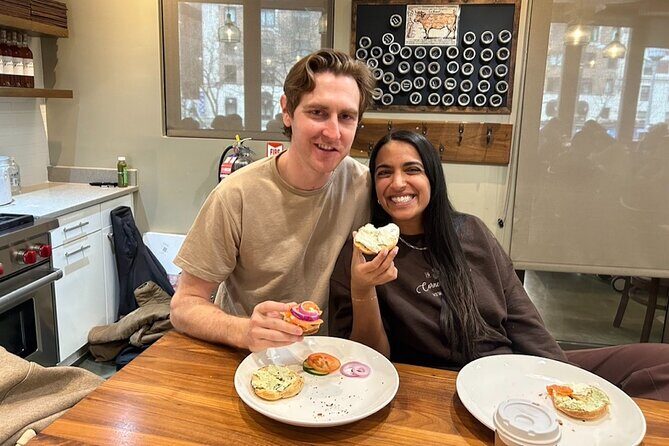
This is the stop that helps the whole tour land in your body and not just your brain. History sticks better when you finish with a smell, a bite, and a plan for what to try next.
Price and Value: Is $39 for One Hour Reasonable?
At $39 per person for about an hour, this tour is built for value in a very specific way: you’re paying for guidance and transportation between sites, not for ticketed admissions inside museums.
That means you’ll get the most value if you treat this as a first pass through Philadelphia’s core highlights. If you try to squeeze full museum visits into a one-hour format, you’ll feel the limits. But if you want to see the landmarks, learn the stories, and decide what to revisit, it’s a strong deal.
Group size also matters. With a maximum of 7 people, it tends to feel more personal than a large bus. That often translates into better answers to questions and fewer awkward time crunches when someone wants a quick photo.
One caution on value: it’s not a “driver does everything for you” private charter. It’s a small group experience with a set rhythm.
What to Bring: Warm Layers, Photo Readiness, and a Plan for Sound
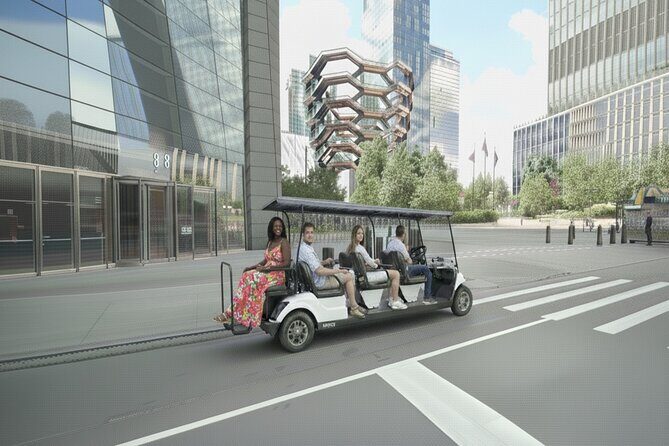
Because the ride is in a vintage-style open car, the most important “bring” item is warmth. Reviews and practical experience point to the same theme: there’s no real heat setup, so in colder months you’ll want proper layers, gloves, and a hat.
You might also find you want a small blanket or extra layer you can manage in your lap. Several guides brought blankets to help keep people warm, which is a nice touch.
For photos, it helps to be ready right away. There are a handful of moments for pictures during the route, and the guide may offer extra chances if you want them—so don’t put your camera away too early.
Sound is the other practical issue. In an open car, the guide’s voice can be hard to hear from the back seat. There are no headsets or built-in speakers noted, so plan to sit where you can hear best and keep your attention up front.
Guides Who Make It Feel Like a Story, Not a Script
A big part of why this tour scores well is the way guides tell the story. Names that show up include Andy, Shane, Xavier, Victor, and Parsa. The common thread is humor mixed with facts, plus an active style—encouraging quick stops if you want to walk around.
Expect guides to tailor the pacing when possible, within the one-hour structure. Some guides also bring a “no stress” vibe, making it feel more like city storytelling with a driver than a strict checklist.
If you care about hearing every word, this matters: you’ll want to position yourself so you can listen comfortably, especially in wind.
Should You Book This One-Hour Vintage Car Tour?
Book it if you:
- Want a fast first-time overview of Philadelphia’s major landmarks
- Like your city tours with humor and stories, not just facts on a loop
- Prefer small group energy (max 7) and a flexible guide who can accommodate quick photo moments
- Need a “day saver” when you’re short on time but still want the big sights
Skip it or adjust your plan if you:
- Want long indoor visits, because some key stops have admission not included
- Hate cold weather discomfort, since it’s an open-air style ride and can be chilly with limited heat
- Need guaranteed privacy or a strict private setup every time—if that’s your priority, confirm the vehicle setup at booking
- Think this will be a fully guided walk-through inside each landmark, because the format is designed for short viewing moments
If you do book it, treat it like the opening chapter of your Philly trip. You’ll finish with a map in your head, a list of places you’ll want to return to, and a much easier time building the rest of your itinerary.
FAQ
How long is the Philadelphia historical sites vintage car tour?
It runs for about one hour.
What is the price per person?
The price is $39.00 per person.
Where do I meet the tour?
You meet at 51 N 12th St, Philadelphia, PA 19107, USA. The tour ends back at the meeting point.
Is the tour offered in English?
Yes, the tour is offered in English.
Is admission included for the Philadelphia Museum of Art or Magic Gardens?
No. The Philadelphia Museum of Art admission ticket is not included, and admission for Philadelphia’s Magic Gardens is also not included.
How large is the group?
The tour has a maximum of 7 travelers.
Are tips included in the price?
No. Tips are not included, and alcoholic beverages are also not included.
Can I cancel for a full refund?
Yes, you can cancel for a full refund if you cancel at least 24 hours in advance. If it’s canceled due to poor weather, you’ll be offered a different date or a full refund.
Are service animals allowed?
Yes, service animals are allowed.