REVIEW · BOSTON
Boston’s Official Freedom Trail® North End Walking Tour
Book on GetYourGuide →Operated by Freedom Trail Foundation · Bookable on GetYourGuide
Red lines, lanterns, and a midnight ride.
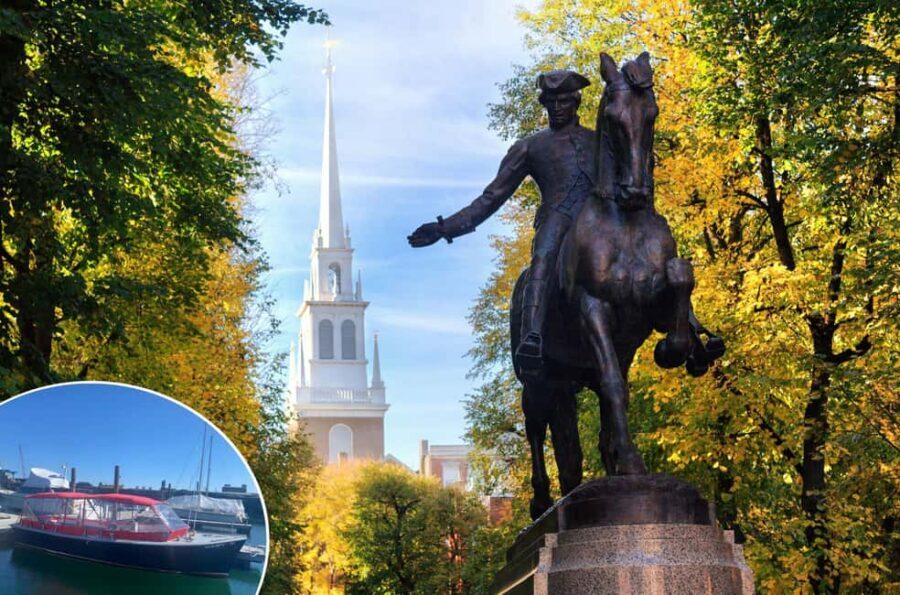
This official Freedom Trail North End walking tour gives you a tight 1.5-hour loop through Boston’s oldest neighborhood, guided by an 18th-century costumed storyteller. I like the way the walk stays focused on the key “scene-setters” of the Revolution—especially the Old North Church and its lantern signal—without turning into a textbook. I also like the built-in time for questions and photos as you move along the red-lined route.
The only real watch-out is that some of the biggest stops charge admission, so the tour experience covers the stories and viewpoints, but you’ll still need to pay separately if you want to go inside.
In This Review
- Key things I’d circle before you go
- Why the North End Freedom Trail walk fits real travel days
- ArtsBoston meeting point: the easiest way to start without stress
- The costumed guide approach: story that matches the streets
- Paul Revere’s story gets the stage, then the streets do the rest
- Old North Church and the two lanterns signal
- Copp’s Hill Burying Ground: the Revolutionary-era quiet moment
- The rest of the Freedom Trail loop: how the 1 mile ties together
- Price and value: what $17 buys you on this route
- What to bring and the walking comfort checklist
- Best for first-timers, families, and history lovers on a schedule
- Should you book this North End Freedom Trail tour?
- FAQ
- How long is Boston’s Official Freedom Trail North End Walking Tour?
- Where do I meet for the tour?
- What does the ticket price include?
- Are museum or church entrances included?
- What should I bring, and is video recording allowed?
- Is the tour wheelchair accessible?
Key things I’d circle before you go
- 18th-century costumed guides who keep the story rolling stop to stop
- Old North Church lanterns and Paul Revere’s midnight ride as the centerpiece
- Copp’s Hill Burying Ground, colonial Boston’s largest graveyard
- About a 1-mile Freedom Trail stretch with lots of photo moments
- Time for questions instead of a race-through-and-off-to-the-next thing
- Ticketed sites aren’t included, so plan for optional add-on entrances
Why the North End Freedom Trail walk fits real travel days
This is a practical Boston history tour: you get a guided route along about 1 mile (1.6 km) of the official Freedom Trail, and it wraps up in 1.5 hours. That timing matters. If you’re juggling a trip that already includes museums and harbor time, a focused walking tour helps you connect the dots without eating your whole afternoon.
The North End setting also does half the work for you. It’s dense, walkable, and full of historic landmarks, so the stories land right where they happened. And because it’s on the official red-lined trail, you’re not guessing where to go next.
You can also read our reviews of more walking tours in Boston



ArtsBoston meeting point: the easiest way to start without stress
You meet at the ArtsBoston Ticket Booth outside Faneuil Hall, near Abercrombie & Fitch. Show up 15 minutes early. This tour asks for a printed voucher to be presented on arrival, so make that a quick pre-departure step rather than something you try to fix at the last minute.
Also note the no-nonsense rules: video recording isn’t allowed. Phones for photos are fine for most people, but the tour is clearly designed for listening and looking, not filming.
The costumed guide approach: story that matches the streets
The big reason this tour gets strong ratings is the guide style. The best parts are when the costumed guide stays in character and answers questions clearly, like you’ve got a friendly history person standing next to you rather than a distant audio track.
I like that you’re not just hearing names and dates. You’re getting the why behind the events—delivered in a way that makes the Revolution feel human-scale. That includes the lead-ins to major moments and the way each stop builds on the last.
And because the tour includes plenty of time for questions and photographs, you can steer the experience a bit. If you’re curious about how the lantern signal worked, or what to pay attention to at Copp’s Hill, you can ask instead of waiting until after the tour.
Paul Revere’s story gets the stage, then the streets do the rest
Early in the walk, you’ll hear the build-up to the midnight ride and how Paul Revere’s actions fit into the wider revolutionary tension. The point isn’t only that it happened, but what it meant at the moment—why speed, signaling, and message-carrying mattered.
You’ll also reference the Paul Revere House area as you follow the official trail. Even when you aren’t going inside (admission isn’t included), the storytelling gives the setting context. It makes it easier for you to understand what you’re seeing rather than just ticking off another landmark photo.
Practical tip: if you want to ask a question, do it early. Once you’re moving deeper into the North End route, you’ll be focused on listening and photographing, and it’s harder to switch gears.
Old North Church and the two lanterns signal
This is the headline stop for many people for a reason. At Old North Church, you’ll get the story of the two lanterns that were lit as a signal, and how that message connected to Paul Revere’s midnight ride.
What I like here is the way the guide uses the physical stop to explain the event. Instead of floating through the concept, you’re standing in the place that anchors the tale. That makes the lantern story easier to remember because it’s tied to a real, specific location.
Photo-wise, this is usually where you’ll want to slow down. The setting is iconic, and you’ll have time for pictures without feeling rushed.





Copp’s Hill Burying Ground: the Revolutionary-era quiet moment
Then comes a very different mood: Copp’s Hill Burying Ground. The tour highlights it as colonial Boston’s largest graveyard, and that label changes how you experience the stop. It’s not only a site with famous names; it’s a big reminder that history lives in ordinary places too.
I find graveyard stops can go two ways on tours: either they get morbid fast, or they stay respectful and informative. This stop works when the guide helps you see what to look for—how the grounds reflect the scale of the community in colonial times, and why these places matter when you’re learning about a revolution.
You’ll also get a chance to breathe here. It breaks up the more action-driven storyline, so you end the walk with a fuller sense of the era rather than just the dramatic moments.
The rest of the Freedom Trail loop: how the 1 mile ties together
Your route follows the official Freedom Trail’s red line through Boston’s oldest neighborhood and includes additional historic places beyond the top two headline stops. The tour doesn’t try to cover every possible site along the trail in one go, because that would turn a 1.5-hour walk into a speed march.
Instead, the idea is connection. Each stop reinforces the main themes: communication during crisis, civic identity, and the way the Revolution shaped the city. If you’re new to Boston history, this format helps you build a mental map quickly.
If you already know the basics, you might still appreciate the guide’s perspective because it points out what to notice at each location. The tour is also structured with time for questions, so you can get follow-ups instead of guessing.
One thing to consider: this is more story-and-location than full timeline lecture. If your goal is a deep, start-to-finish explanation of every Freedom Trail event, you may wish the guide had more time. Still, the trade-off is that the tour stays energetic and manageable.
Price and value: what $17 buys you on this route
At $17 per person for a 1.5-hour guided walk, this is one of the simpler ways to get oriented on the Freedom Trail. You’re paying for more than movement around Boston. You’re paying for an 18th-century costumed guide, story delivery at multiple stops, and the structure of an official trail segment so you don’t waste time figuring out the route.
What’s included:
- A 1.5-hour walking tour covering about 1 mile of official Freedom Trail historic sites
- 18th-century costumed guides
- Local taxes and fees
What’s not included:
- Entrance tickets for Freedom Trail sites that charge admission, including Old South Meeting House, Old State House, Old North Church, and Paul Revere House
So here’s the value lens I’d use: if you mainly want the stories, the viewpoints, and the quick path through the key North End locations, the tour does its job. If you plan to go inside multiple ticketed sites, you’ll want to budget extra and expect a little more time spent on entry logistics.
The tour also lists skip the ticket line, which suggests the experience is set up to keep you from losing time right when you arrive at ticketed stops. The exact method can vary, but the intent is clear: don’t turn history into a queue.
What to bring and the walking comfort checklist
Bring comfortable shoes. This is an urban walking tour with around 1 mile on the official route, plus time standing at stops for photos and questions. Also bring water, especially on warm Boston afternoons.
Because video recording isn’t allowed, plan to rely on photos and notes instead of filming. If you love capturing details, bring a phone with enough battery for pictures, since that’s how you’ll “save” your tour moments.
Best for first-timers, families, and history lovers on a schedule
This tour is a great fit if you want:
- A first look at Boston’s Freedom Trail with a guide-led storyline
- A North End plan that doesn’t require museum-level commitment
- A Revolutionary-era focus centered on Paul Revere and the North End’s landmarks
- A group activity with time to ask questions and take photos
If you’re traveling with kids, the costumed guide format can be a big win. It tends to turn “facts on a street corner” into a more memorable experience. If you’re an experienced Boston history person, you’ll likely still enjoy it, but you might find yourself wanting more depth on the full Freedom Trail arc.
Should you book this North End Freedom Trail tour?
I’d book this tour if you want a well-paced, guide-led way to understand the North End’s role in the Revolution, anchored by the lantern signal at Old North Church and the dramatic setup of Paul Revere’s midnight ride. The 18th-century costumed guide format is the core value here, and the chance to ask questions makes it feel like more than a scripted walk.
I’d think twice if your priority is entering every major Freedom Trail building. Since admission for several sites isn’t included, you’ll likely want a separate plan for indoor visits. In that case, you can still book the walking tour, but treat it as the story primer and route map—not the full museum day.
If you match those priorities, this $17, 1.5-hour walk is a smart use of time in Boston. You’ll leave with a clearer sense of how the North End connects to the bigger Freedom Trail story.
FAQ
How long is Boston’s Official Freedom Trail North End Walking Tour?
The tour lasts 1.5 hours, and it covers about 1 mile of official Freedom Trail historic sites.
Where do I meet for the tour?
You meet at the ArtsBoston Ticket Booth outside Faneuil Hall, located near Abercrombie & Fitch.
What does the ticket price include?
It includes the 1.5-hour walking tour (about 1 mile of official Freedom Trail sites), a live English-speaking 18th-century costumed guide, and local taxes and fees.
Are museum or church entrances included?
No. Entrance is not included for Freedom Trail sites that charge admission, including Old South Meeting House, Old State House, Old North Church, and Paul Revere House. Tickets for those can be purchased at the door.
What should I bring, and is video recording allowed?
Bring comfortable shoes and water. Video recording is not allowed.
Is the tour wheelchair accessible?
Yes, the tour is listed as wheelchair accessible.